

If you believe the history book narrative and modern day media, TV and films, ancient Romans had a reputation for wild excesses of all kinds. "Caligula", "Gladiator" and even the bawdy comedy of "Plebs" and the 70's "Up Pompeii!", showed that the Romans enjoyed a drink, They really enjoyed a drink.
The mosaique pictured above shows a typical grape harvest from this era of outrageous activities with even the picker climbing his ladder into the vines apparently deciding to remain naked. There must be a reason for doing so, but who are we to judge? You'd be arrested if you tried it today!
What's that well-known phrase? Oh, yes... "What did the Romans ever do for us?" Now we have the answer. It's all down to them spreading the idea of wine around the world. Just think, here in the U.K, we'd be stuck with drinking mead and sour tasting water wihout Julius Caesar's intervention all those centuries ago.
The art of winemaking has an enormously long history, dating back around 8000 years in the Caucasus region of Georgia, Armenia and Azerbaijan where wine has been made in the same traditonal and natural way to this day. Some ideas just work! Native vines grew wild in trees and wine, itself, was almost an accidental byproduct. Harvested grapes had to be stored, but some were damaged and, when the wild yeast on the skins came into contact with the grape juice, fermentation started naturally with the result being wine (of sorts) ... and people loved it! Eventually, someone worked out how to repeat this process and the job of winemaker came into being. Much experimentation led to ways of keeping the wine drinkable over a long period, with sealed clay vessels being the first to be used for this purpose. All sorts of strange animal/vegetable/mineral products were either added to the wine, or used to seal the storage containers themselves. Wine, back then, didn't taste like it does today.
Moving on several thousand years to the Roman Empire, things began to move rapidly up a gear with advances in technology, buililding techniques, roads and transport, and the large scale agriculture and viticulture requirements needed to service the occupying legions and new settlements around Europe.
In Spain (Roman Hispania), the southern cities of Cadiz and Jerez, with their early Phoenician and Etruscan influences, were forerunners in the province of Andalusia, with further developments coming along the Mediterranean coast in both Catalonia and Tarragona, and in the more northerly, inland regions including Rioja. The area's Ebro River was used to move the large numbers of wine amphorae (clay/terracotta storage containers) by boat to the Mediterrnean ports in the east, and further afield around the empire. Commercial winemaking had arrived and it was achieved by the Romans.
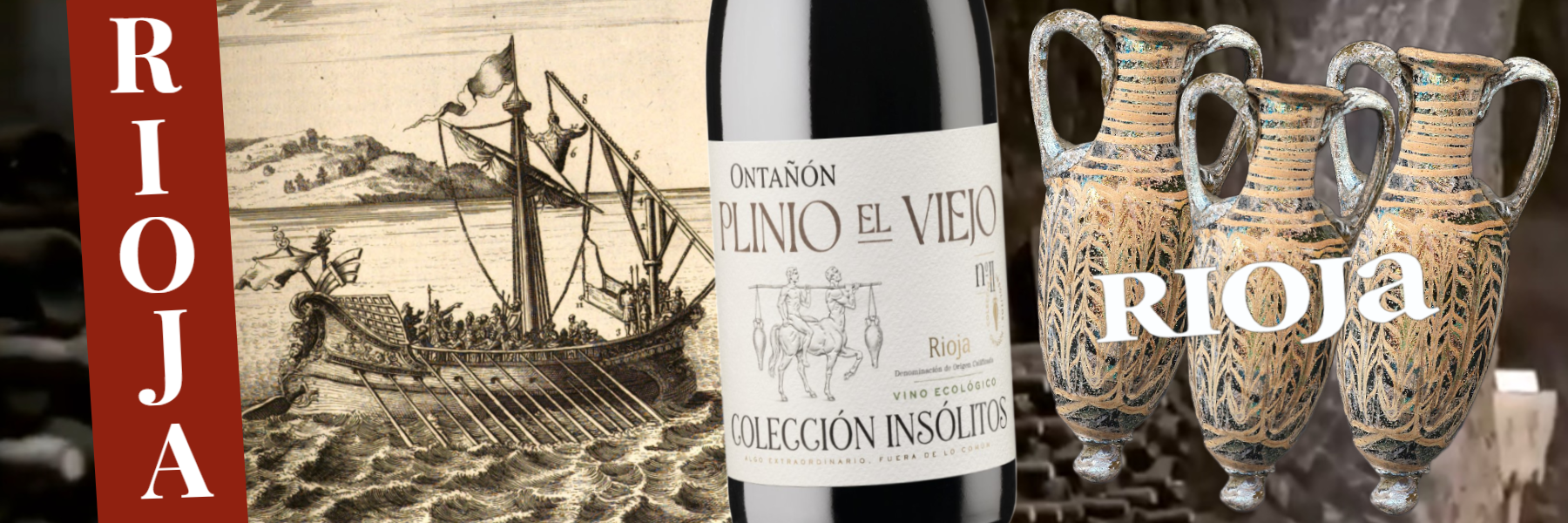
Gaius Plinius, known as Pliny the Elder (Plinio El Viejo), was a Roman writer from the 1st century AD and author of the "Naturalis Historia" encyclopaedia, published in the year 77 AD. In its 37 volumes, Pliny’s Natural History is regarded as the first great encyclopaedic collection of the Ancient World and it places special emphasis on the world of wine and vine growing. Volume 14 is exclusively dedicated to wine; volume 17 contains descriptions of the techniques of viticulture of his times and at the beginning of volume 23 there are various comments about the curative powers of wine. What is certain is that no other author of Antiquity dealt with winemaking and vine growing so thoroughly. In today's parlance, a true "wine nerd"!
Pliny reached the conclusion that the territory and the soil determine the quality of the wine and mentioned such advanced techniques as sulphuring or using wooden vessels for storing wine. He recounted that the Roman legionaries carried vine canes with their campaign equipment and would progressively plant vines in the conquered lands. Pliny also knew and described wines from other territories not from the Italian Peninsula, especially those from Iberia. He was of the opinion that vines need to be pruned every year and that all their force goes to the branches or go down to its shoots, and from there it spreads in different ways, depending on the climate conditions or the properties of the soil.
The Balisca vine, thought to be grown in northern Spain by the Phoenicians, is possibly the variety taken into Gaul (France) by the Roman legionaries. Planted in Bordeaux, it is thought to have ancient links to both the Cabernet family of grapes and possibly even Tempranillo.

Taking inspiration from the work of Pliny, winemaker Rubén Pérez Cuevas of Bodegas Ontanon, based in Logrono, explains that, "An organic wine is not a challenge, it is a philosophy, a way of acting that we apply to all ways of making, treating the vineyard, caring for the wine and bottling it with the utmost respect for nature." Rubén stresses, "it is a must to make a wine that represents respect and love for nature..."
The Coleccion Insólitos range by Ontanon includes a red wine made from 100% organic Tempranillo grapes which is named after the master himself, "Plinio El Viejo". It showcases the character of this cultivar which is the mainstay of Rioja production.
Terroir is all important, and the grapes for this wine come from one of the bodega’s most special vineyards: Andañal, a plot located at an altitude of over 720 metres above sea level on the slopes of the Sierra de Yerga in the Quel district, more specifically, in the foothills of Monte Gatún. These vines, planted in 1995, 2012 and 2016, are certified as organic and have a sandy loam textured soil. Its height means that ripening is very slow and absolutely perfect for the Tempranillo to show off its best notes of finesse, expression and subtlety.
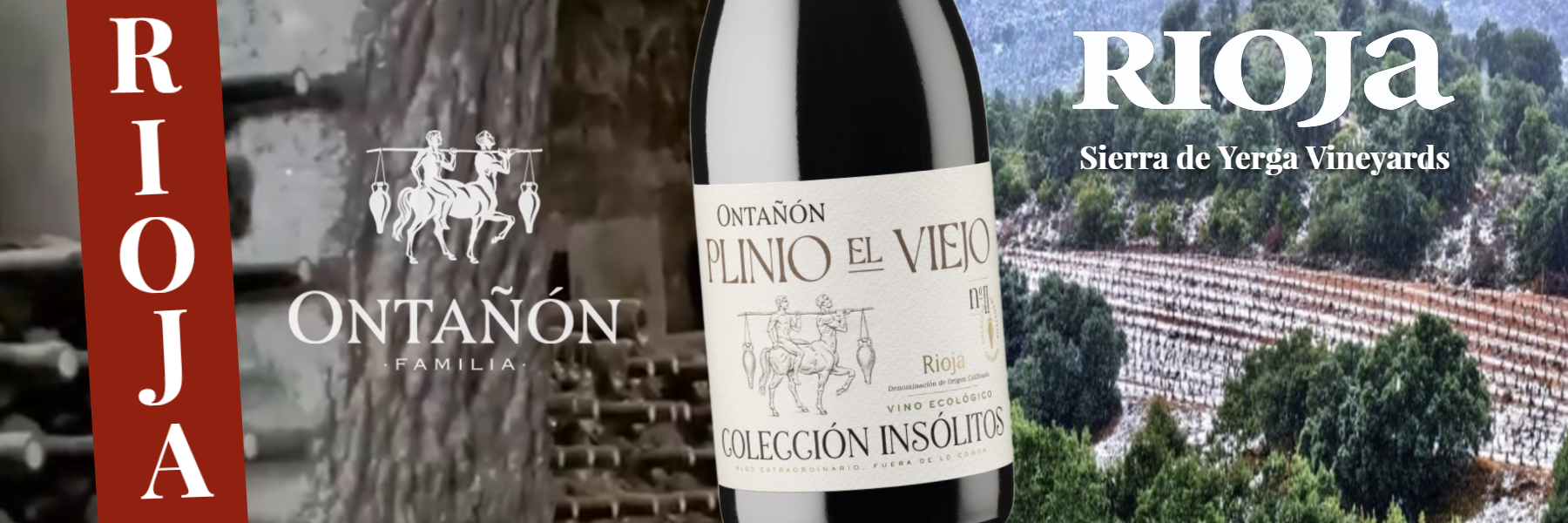
Ontanon's Andañal vineyard on the snow covered slopes of the Sierra de Yerga
Winemaking practices are key, and letting the grapes have a 3 day period of cold maceration before fermentation begins allows the wild yeasts to naturally extract more of the grapes’ primary aromas of blackcurrants, blackberries, plums and violets, as well as the aromas of scrubland which are so typical in this territory.
After fermentation, the wine is left up to 10 more days in contact wiih the grape skins amd, after devatting, the malolactic fermetation is allowed to proceed which fixes the wine's colour and adds the characteristic, secondary lactic aromas. Fining occurs naturally, with the wine being left to settle in vat for four months.
The aromas and flavours of many Rioja wines are influenced by oak. The amount of time spemt ageing in barrel is regulated for the various categories (Crianza, Reserva & Gran Reserva) but, for this particular example with only 3-4 months of wood contact, the aim is to emphasise the quality of the fruit. The barrels are specially constructed using a combination of French and American oak staves, with the barrel ends being French only. It's all about micro-oxygenation, where the wine breathes through the pores in the wood. Due to the different climatic growing conditions these oak trees produce a varied tightness of the grain, allowing the barrels different rates of oxygen flow into the wine inside, thereby affecting its maturation, develoment and flavour profile. Only organic wine ever comes into contact with these barrels and a mixture of new and used wood is specified for the Plinio El Viejo wine.
The final production stage is further maturation in bottle, letting the wine achieve balance and roundness, making it ready for drinking by the consumer. Most Rioja is given the necessary ageing by the bodega before release onto the market, so you can always be sure of the wine being perfect.
Pliny knew much of this thousands of years' ago, but every day's a school day in the world of viticulture and vinification, and there's always more knowledge you can use to produce better wines.
I hope you've been taking notes, as there will now be a short exam on the history of vine growing and winemaking from the Roman era to the modern day. Your time starts NOW!